





 National War Tax Resistance Coordinating Committee
40 Years of Resistance
More Than a Paycheck,
REFUSING to PAY for WAR
Contents
-
- NWTRCC Gathering in Las Vegas November 6-8, 2026
By Lincoln Rice - Reflect, Educate, Act
By Chrissy Kirchhoefer - Counseling Notes: IRS and ICE • IRS use of Artificial Intelligence
- Many Thanks to everyone who supports NWTRCC with their volunteer time or financial donations
- Network Updates
- Network News and Outreach Reports: World Beyond War Spotlights War Tax Resister • Catholic Workers in Iowa Discuss War Tax Resistance • 1,000,000 Visitors to Website!!! • Tabling at Veterans for Peace Conference
- International News: Conscience and Peace Tax International Conference Update
By Lincoln Rice - War Tax Resistance Resources: War Tax Resistance Guide Available as Paperback & E-Book
- Update from the New England War Tax Resistance Alternative Fund
By Em Jacoby - Profile: Not paying for war: One congregation’s journey
By Joanna Lawrence Shenk
Click here to download a PDF of the October/November issue
NWTRCC Gathering in Las Vegas November 6-8, 2026
By Lincoln Rice
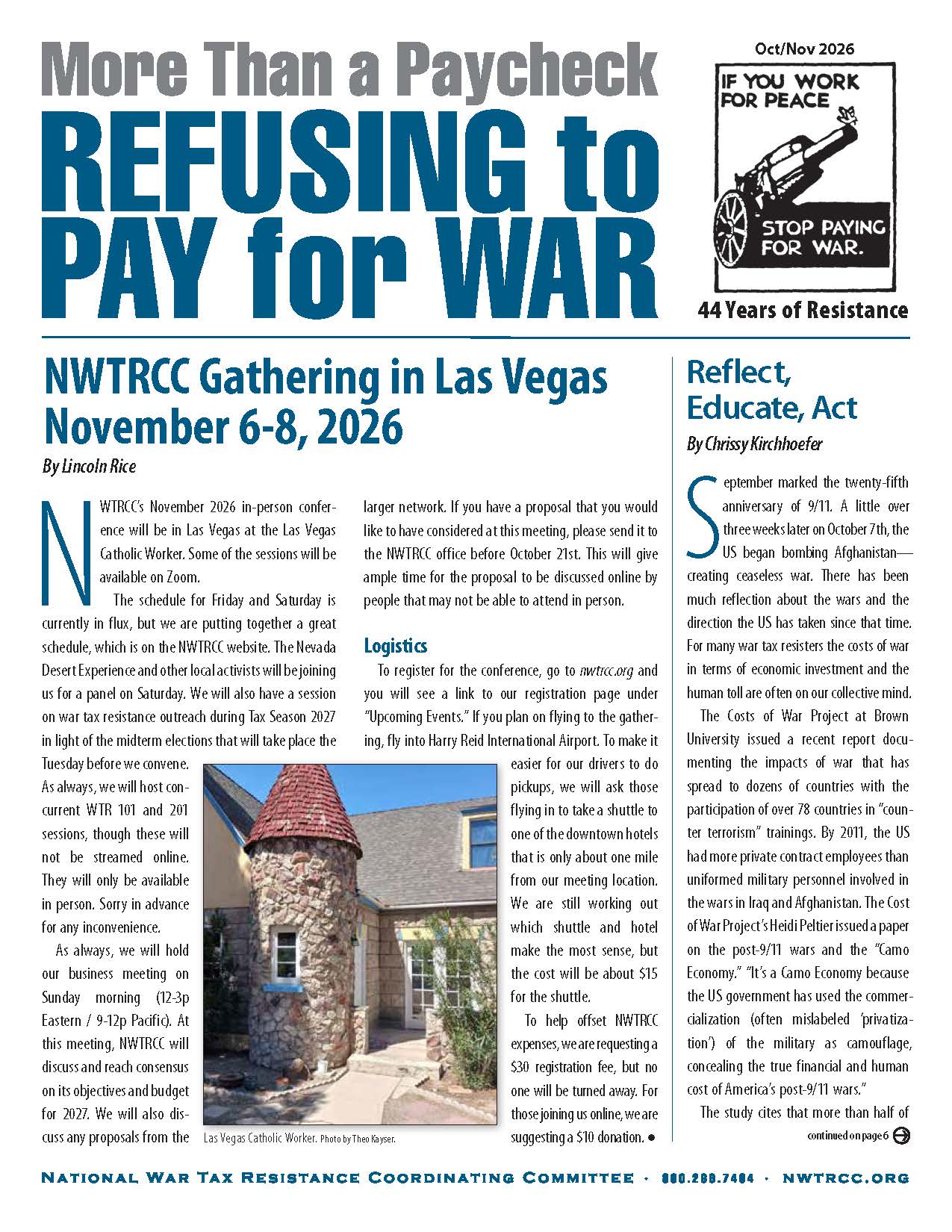
NWTRCC’s November 2026 in-person conference will be in Las Vegas at the Las Vegas Catholic Worker. Some of the sessions will be available on Zoom.

Las Vegas Catholic Worker Photo by Theo Kaiser
The schedule for Friday and Saturday is currently in flux, but we are putting together a great schedule, which is on the NWTRCC website. The Nevada Desert Experience and other local activists will be joining us for a panel on Saturday. We will also have a session on war tax resistance outreach during Tax Season 2027 in light of the midterm elections that will take place the Tuesday before we convene. As always, we will host concurrent WTR 101 and 201 sessions, though these will not be streamed online. They will only be available in person. Sorry in advance for any inconvenience.
As always, we will hold our business meeting on Sunday morning (12-3p Eastern / 9-12p Pacific). At this meeting, NWTRCC will discuss and reach consensus on its objectives and budget for 2027. We will also discuss any proposals from the larger network. If you have a proposal that you would like to have considered at this meeting, please send it to the NWTRCC office before October 21st. This will give ample time for the proposal to be discussed online by people that may not be able to attend in person.
Logistics
To register for the conference, go to nwtrcc.org and you will see a link to our registration page under “Upcoming Events.” If you plan on flying to the gathering, fly into Harry Reid International Airport. To make it easier for our drivers to do pickups, we will ask those flying in to take a shuttle to one of the downtown hotels that is only about one mile from our meeting location. We are still working out which shuttle and hotel make the most sense, but the cost will be about $15 for the shuttle.
To help offset NWTRCC expenses, we are requesting a $30 registration fee, but no one will be turned away. For those joining us online, we are suggesting a $10 donation.
Reflect, Educate, Act
By Chrissy Kirchhoefer
September marked the twenty-fifth anniversary of 9/11. A little over three weeks later on October 7th, the US began bombing Afghanistan—creating ceaseless war. There has been much reflection about the wars and the direction the US has taken since that time. For many war tax resisters the costs of war in terms of economic investment and the human toll are often on our collective mind.
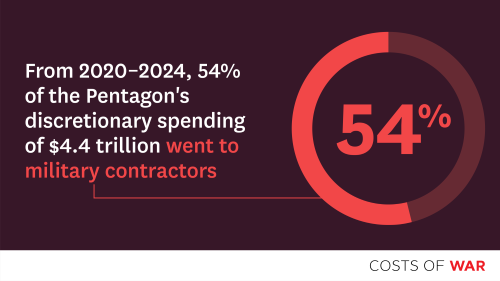
The Costs of War Project at Brown University issued a recent report documenting the impacts of war that has spread to dozens of countries with the participation of over 78 countries in “counter terrorism” trainings. By 2011, the US had more private contract employees than uniformed military personnel involved in the wars in Iraq and Afghanistan. The Cost of War Project’s Heidi Peltier issued a paper on the post-9/11 wars and the “Camo Economy.” “It’s a Camo Economy because the US government has used the commercialization (often mislabeled ‘privatization’) of the military as camouflage, concealing the true financial and human cost of America’s post-9/11 wars.”
The study cites that more than half of the contract workers were “Host Country Nationals” or “Third Party Nationals,” migrant laborers who face the worst exploitation. Thirty to forty percent of spending on contractors is lost to waste, fraud, and abuse. In another study by the Costs of War Project, they estimate that the US will have spent as much money on the interest payment as it did on overseas contingency operations for the war themselves, leading some to call these “credit card wars.”
From October 7, 2023 until September 2025, the US has spent about $34 billion in military aid to Israel and operations in the area. In July, the Pentagon estimated the cost of war in Iran was $47 billion yet other sources cite a cost to taxpayers at $113 billion.
The twenty-year war in Afghanistan left behind $7 billion worth of equipment and the return of the Taliban to power. The promise of those who worked with the US military to have refuge in the US has been rescinded leading to many refugees being deported to Afghanistan and almost certain death.
With this anniversary, I find myself reflecting. Twenty-five years marks the halfway mark of my life. Prior to 9/11, I was living and working with Vietnam Veterans who were impacted by the war that had ended twenty-five years earlier, yet the impacts of the war were still disrupting their lives. I had committed to refusing to pay for war prior to that, but these relationships solidified my resolve. Lastly, I am reminded of a familiar refrain of that time twenty-five years ago that continues to be applicable today: “Our grief is not a call for war.”
Counseling Notes
Purpose of this Section
This section serves as a hub for war tax resisters to keep abreast of the kind of actions the IRS is taking to collect federal tax debt. It also aids WTR Counselors, who are war tax resisters who volunteer to support existing and potential resisters. These counselors have undergone a day-long training to non-directively counsel individuals and aid them in determining their goals in regards to WTR, to discover the options most appropriate to their situation, and to assess realistically the possible consequences of those options. A current list of counselors by state can be found on the NWTRCC website (go to the “About Us” tab and click “Local Contacts & Counselors”). This training is usually offered once a year in February. If you would be interested in attending one of these trainings, please contact the NWTRCC office at nwtrcc@nwtrcc.org or (800) 269-7464.
IRS and ICE
In early September, a federal appeals court upheld a lower court ruling from last year blocking information sharing between the IRS and Immigration and Customs Enforcement (ICE. The three-judge panel for the Court of Appeals for the DC Circuit found ICE’s request for the last-known addresses of 1.28 million people who may be unlawfully present in the violated laws established in the wake of the Watergate scandal that bars the IRS from sharing information with other agencies unless it meets “stringent conditions.”
The IRS can share information with other agencies to help prosecute certain crimes for specified individuals. “The IRS failed to require ICE to provide a ‘specific reason’ why the requested return information ‘is or may be relevant to [a qualifying] proceeding or investigation,’ as the statute demands,” wrote Judge Cornelia Pillard. ICE also listed the same government employee as investing criminal acts for all 1.28 million addresses requested. The judges balked at the notion that one person was handling 1.28 criminal cases. At present, the prohibition on IRS sharing data with ICE remains in place as the litigation continues.
IRS use of Artificial Intelligence
The IRS has not been very transparent on how it uses AI, but a March 2026 report from the Government Accountability Office (GAO) sheds some light on current use and its associated problems. It reported that the IRS mostly uses AI to increase operational efficiency, then to evaluate tax compliance and detect tax fraud, and then to help with taxpayer services.
Operational efficiency includes transcription, translation, cybersecurity, internal chatbots, and digitalization. Regarding the evaluation of tax compliance and detection of tax fraud, AI is supposed to flag and rank potential problems with taxpayer filings, but then an IRS employee decides whether to take action or not. Taxpayer services include public voice and chat bots, simplifying tax notices, and verifying the identities of taxpayers accessing IRS online accounts.
There were also instances of AI use that the IRS stated it could not divulge because it pertained to sensitive issues. The report also highlighted that Trump’s personnel cuts to the IRS have harmed the agency’s ability to ensure that AI is always producing useful and accurate results. For example, the IRS has not identified any skill gaps with AI that would require a human to check the results.
Many Thanks
Thanks to each of you who donate to NWTRCC! Remember, you can also donate online through PayPal and Venmo (not tax deductible) or Resist (tax deductible) by clicking on the “Donate” button at nwtrcc@nwtrcc.org. (Please let the NWTRCC office know if you use Resist.) It’s never too late to send that contribution to support our work.
We are very grateful to these alternative funds and WTR groups for their redirections and Affiliate dues: Western Washington Fellowship of Reconciliation
Network Updates
The Network List of Affiliates, Area Contacts, Counselors, and Alternative Funds is updated and online at nwtrcc.org, or contact the NWTRCC office (nwtrcc@nwtrcc.org or (800) 269-7464), if you would like a printed list by mail.
Don’t forget, you can find us on
Facebook • Twitter • YouTube • Instagram •
or join our discussion listserve.
Click on the icons at nwtrcc.orgAdvertise to Activists! See the advertising rates for this newsletter or contact the editor at (800) 269‒7464.
Consider a Bequest
NWTRCC accepts bequests which can be arranged through your will or other estate plan.
Simply name NWTRCC as the beneficiary of a portion of your estate or of particular assets in your estate, or contact the NWTRCC office for arrangements through one of our 501c3 fiscal sponsors. A bequest costs nothing now, yet it may give you great satisfaction to know that your gift will live on in NWTRCC.
More information: nwtrcc.org/bequests, (800) 269-7464, or nwtrcc@nwtrcc.org.
“I have been donating quarterly to NWTRCC for many years, because as a life-long war tax resister I feel I definitely need NWTRCC to be there and to be strong.”
— Becky Pierce, Dorchester, Mass.
Please join Becky as an annual, monthly, or quarterly pledger to NWTRCC. See the donate page on our website to pledge through Paypal (any amount monthly) or through Resist (monthly, quarterly, and annual options). If you would like a pledge packet to give by check, please contact the NWTRCC office, 800-269-7464.
Are you organizing an action, training, or gathering?
Got a good photo of your war tax resister community in action?
Keep us in the loopWe’re all about building the community of resisters.
We’d love to celebrate you + help spread the word. Email Chrissy Kirchhoefer (Our Outreach Consultant):outreach@nwtrcc.orgDonate by Venmo

NWTRCC now accepts donations by Venmo! We still accept donations by check, PayPal, and credit/debit card using PayPal. Also, tax deductible donations can be made by check or credit/debit card using one of our fiscal sponsors. For more information on all the ways you can donate to NWTRCC, go to nwtrcc.org/donate.
Network News and Outreach Reports:
World Beyond War Spotlights War Tax Resister
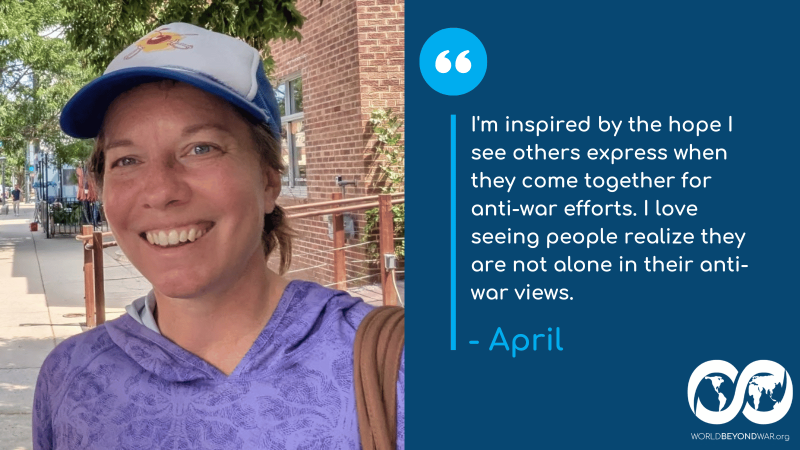
This summer, World Beyond War placed their Volunteer Spotlight on April Peterson, who is active with the World Beyond War chapter in Madison, Wisconsin. April connected with the WBW-Madison Chapter in the summer of 2025 through their weekly vigils with Madison Rafah Sister City Project protesting the genocide in Palestine. April is currently co-leading the War Tax Resistance working group for their chapter, which has been holding regular in-person war tax resistance information sessions. Thank you April for your work!!!
Catholic Workers in Iowa Discuss War Tax Resistance
Since 1978, Catholic Workers in the Midwest have gathered in rural Iowa in mid-September to build community, swap stories, and have a bunch of round-table discussions. About 60 adults and 15 children were in attendance, including NWTRCC consultants Lincoln Rice and Chrissy Kirchhoefer.
For about the last 10 years, the gathering has featured a round table on war tax resistance, which this year brought together ten people who were mostly new to war tax resistance. In addition to the basics of war tax resistance, there was discussion on resisting as a business, alternative funds, social security, state income taxes, and artificial intelligence. Throughout the weekend, many Catholic Workers who had attended previous WTR> sessions had conversations with Lincoln and Chrissy about their current WTR> situations.
— Report from Lincoln Rice & Chrissy Kirchhoefer
1,000,000 Visitors to Website!!!
We measure interest in war tax resistance by unique visits to our website. Before the invasion of Gaza, NWTRCC had steady internet traffic of 40,000 unique visitors to our website each year. In 2024, annual visits to our website were nearly 150,000. In 2025, we had nearly 400,000 visits to our website. As of September 1, 2026, we have already surpassed 1 million unique visitors for the year!
Tabling at Veterans for Peace Conference
The Veterans for Peace national conference took place at Missouri University August 6-9, 2026. We are thankful for Jane Stover, who brought NWTRCC materials to the conference and tabled on behalf of NWTRCC!!!
International News
Conscience and Peace Tax International Conference Update
By Lincoln Rice

Conscience and Peace Tax International (CPTI) is an international non-profit association with “special consultative status” with the Economic and Social Council (ECOSOC) of the United Nations since July 1999. They meet every two years and their most recent meeting was on September 4-6, 2026. The meeting was in Brussels, but people also attended using Zoom.
Because of the time difference, I signed into Zoom early Saturday morning just before 2:30a for me in Milwaukee, Wisconsin. The other people Zooming included Ruth Benn in New York, Eleanor Forman in New York, Derek Brett with CPTI in Switzerland, Joelle DuBois and John Williams in Belgium, Sian Cwper with Conscience UK in Wales, Penny Heymans in Sweden, and Nisanur Cim with the Quaker Council for European Affairs in Turkey.
Their theme for this conference was Give Peace a Budget. There appeared to be seventeen people attending in person. The in-person participants were from Belgium, Germany, Switzerland, England, and Russia. The common language at the conference was English.
The conference began with country reports. The Belgium group Vr.ac (actie vredesbelasting) gave the first report. Their current focus is starting a Peace Tax Campaign where participants will redirect 11% of taxes owed to a separate provisional peace tax fund until Belgium passes formal Peace Tax Fund legislation. After resisters receive formal notice from the revenue office, most will request the provisional peace tax fund to pay the 11% on their behalf. Some may choose to still refuse to pay, but the group will advise participants to pay their resisted taxes since the group does not have the resources to provide legal and moral support. 11% represents their military and military-related expenditures. Their goal is to have 1,000 people participate.
I then provided the US report for NWTRCC and shared the large increase in interest in war tax resistance information since the invasion of Gaza in late 2023. The increase in interest we have seen in the US has not been mirrored in other countries.

The Germany group, Netzwerk Friedenssteuer, discussed how the invasion of Ukraine by Russia has caused difficulties for peace groups in Germany in light of legitimate safety concerns. (e.g., Russia has attacked some infrastructure in Germany and other European countries.) Some supporters have left and become more supportive of the German military. These events are also leading peace groups to become more active. Nonpayment of taxes in Germany is not a crime and participants only risk a civil penalty. Nevertheless, the revenue office is aggressive and Netzwerk Friedenssteuer doesn’t currently have a lawyer. Without a lawyer, you cannot appeal court cases to the federal court. Previous appeals were not successful, but they still desire to appeal cases.
The English group, Conscience UK, changed their immediate priority to raising awareness and building support while keeping peace tax legislation as a long-term goal. There is

Conscience UK logo
growing support for higher military spending and conscription as a response to lack of US military support under Trump. In 2025, Conscience UK began a social media campaign #PeaceTaxTuesday to highlight their peace tax campaign in light of troubling headlines. As the name indicates, they post on social media each Tuesday. This consistency has led to significant growth on Facebook and Instagram.
The actor Sir Mark Rylance also spoke during the year about his refusal to pay taxes because of its connection to genocide in Gaza.
Jez Smith of Switzerland, where there is not a WTR group, shared that men who don’t serve in the military are forced to pay a tax penalty to financially support the military. There is also an upcoming referendum in late-September on Swiss neutrality that is bringing its military spending to the fore. The “Neutrality Initiative” is a constitutional proposal seeking to mandate a rigid, stricter interpretation of Switzerland’s permanent, armed neutrality. The measure would ban participation in military alliances and economic sanctions against warring states, barring UN mandates. If approved, Switzerland would have to stop their sanctions on Russia. (The measure failed.)
Alexandr Andrevich from the Russian Tolstoy Centre discussed withdrawal of Russia from several international treaties related to militarism and nuclear weapons. Repression against anti-war activists had led to around 700 activists currently being detained. Unfortunately, there is no interest among activists in war tax resistance or peace tax legislation as an extension of conscientious objection. Instead, people have spoken with their feet, with 650,000 to 800,000 people having fled Russia since 2022. He viewed this largely as a stance against paying for the Ukraine war and conscription.
I was too tired to attend the Sunday sessions, which again began at 2:30a Milwaukee time, but CPTI discussed their Report for the United Nations / Human Rights Council with discussion of their goals for the next two years. They also discussed cooperation with other international peace organizations, including World beyond War (WBW), European Bureau of Conscientious Objection (EBCO), International Fellowship of Reconciliation (IFOR), Pax Christi International, and Global Days of Action on Military Spending (GDAMS).
They did record the sessions, but the sessions have not been posted online at this time.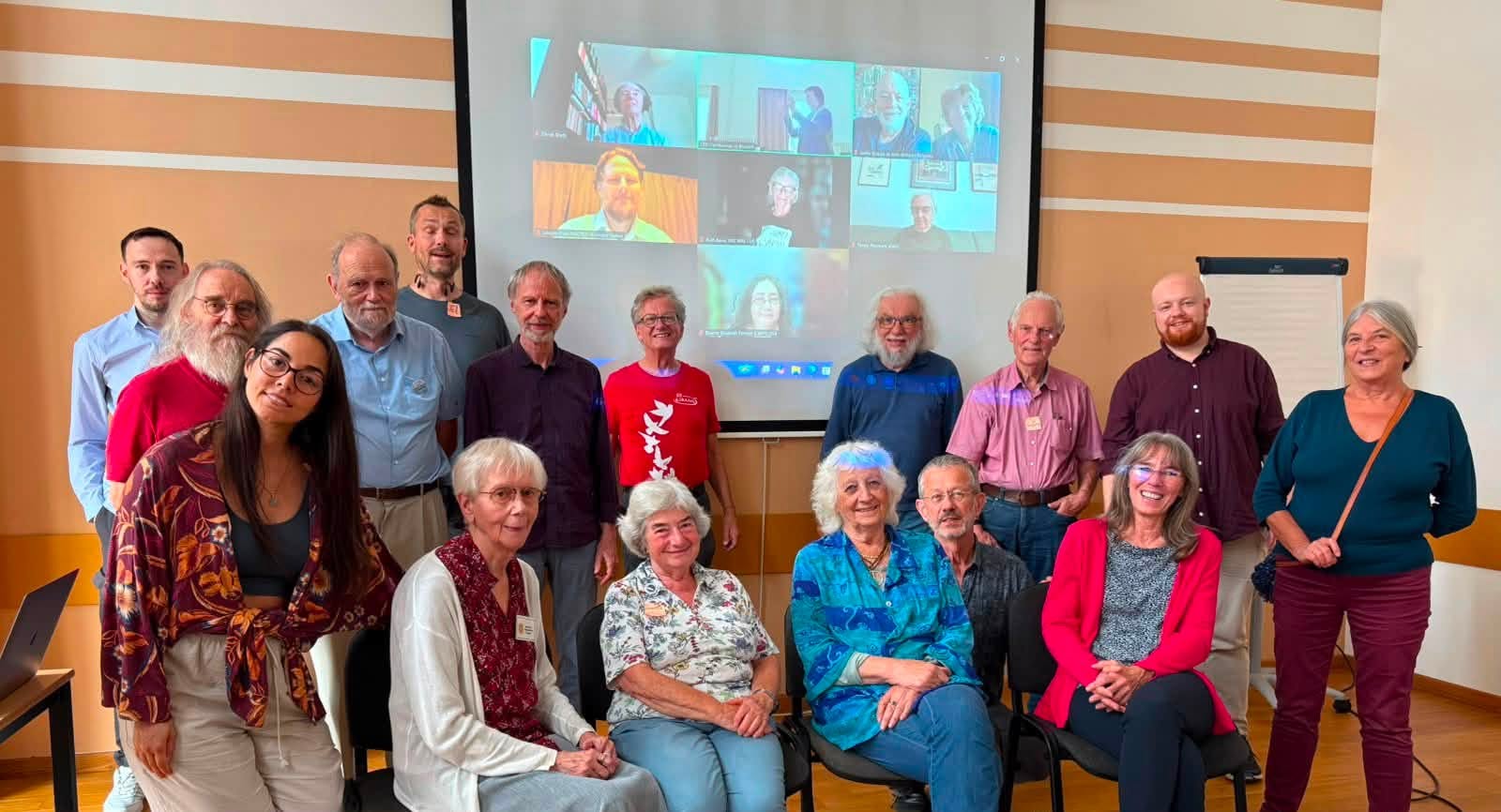
CPTI group photo. Courtesy of Conscience UK
War Tax Resistance Resources
War Tax Resistance Guide Available as Paperback & E-Book

For those who want to avoid paper and love reading on their electronic devices, you can now purchase the new edition of the War Tax Resistance Guide as an e-book. It sells for $12.99 on Amazon Kindle, Barnes & Noble Nook, Bol. (France), Booktopia (Australia), eBooks.com, Everand, Hugendubel (Germany), Porrúa (Mexico). If you prefer paper, you can still purchase the book from the store on the NWTRCC website for $20 plus shipping.
Update from the New England War Tax Resistance Alternative Fund
By Em Jacoby

Em Jacoby, Fund Manager for the New War Tax Resistance Alternative Fund.
Last night, like many Sunday nights, my household of five headed to the near South Side of Chicago to partake in a community meal program with wraparound services for those experiencing food and housing insecurity. The weather recently turned from oppressive heat and humidity to cool rain. It had rained relentlessly for days, and everything was soaked. For those who carry what they own on a few crumbling suitcase wheels or keep belongings in a tent that has a high risk of theft and vandalism, a dramatic weather shift brings desperation. There is no coat closet waiting for them with last spring’s jackets. We try to meet needs, listen, and create comfort where we can. We wrote up a list of sizes and clothing needs, dug through bins of donations, and supplied what we could. For those who walked away without enough, we will try to find supplies for next week, but we rely on donations from other organizations that also rely on donations. We can promise that no one will leave our meal hungry, but with rain boots, coats, housing, and sufficient preventative care? Sigh, we really try.
The myth is that there is not enough, and I know you understand this is deeply connected to war tax resistance. There actually is enough. We can have a world where all are fed, clothed, housed, and receiving health care; better yet, we can have a world where all are thriving. We are in this fight for federal taxes to fund our communities’ needs.
A little more than a year ago I became the Fund Manager for New England War Tax Resistance, a group started in 1968 in the Boston area to support and educate on war tax resistance. Over time, as various groups dissolved that had started during the Vietnam War, New England War Tax Resistance became national. I am based in Chicago, and here to support anyone who owes federal taxes. One of our more unique services is providing grants every April 15 from funds pooled together by war tax resisters and giving the interest from our pooled resources to the community non-profits our resistors want to see funded. (Reach out for more details!)
I have heard many in the war tax resistance movement express concern about the waning capacity and the aging population of resisters. Being nearly half the age of the former Fund Manager Becky Pierce, who was a fabulous war tax resistance counselor and excellent at finding ways to fund communities, I am taking seriously the task of bridging younger folks with those who have decades of experience as resisters.
In March, I began the Instagram page, @ne_WarTaxResistance, partnering with NWTRCC to provide snippets of information, listing a resistance myth, and dispelling the myth in a few photos. These posts reach 8,000 people on average. With help from an artist friend, I created a one-page zine that is handy for tabling at events, mailing to those exploring war tax resistance, sticking in Little Free Libraries, and passing out at anti-war protests. Knowing that there is a lot of concern for surveillance for any sort of resistance to the government, I offer support over Proton Mail (a free encrypted email platform that is non-profit) and Signal chat (also a non-profit but for texts and calls). I also am happy to show up in-person or virtually to share the resources of New England War Tax Resistance.
As I speak with folks learning about war tax resistance for the first time, returning to it after many years, or those continuing for decades, what I find most interesting is that this movement unites so many other movements. We are truly diverse. There are people finding themselves at War Tax Resistance 101’s who have never protested in any other form. There are folks who say they are here because their very existence is being threatened and they would have been here sooner if they had heard of us. There are folks who tell me their families think they are extreme, but really they just want peace.
Just like the guests of the community meal program, we all want a space where our needs are met, we are listened to, and we feel supported. Let’s continue to do this for war tax resistance. (New England War Tax Resistance can be contacted via email at NEWTresistance@proton.me.)
Profile
Not paying for war: One congregation’s journey
By Joanna Lawrence Shenk
[Editor’s Note: This article originally appeared online at Anabaptist World on August 12, 2026. Used with permission.]
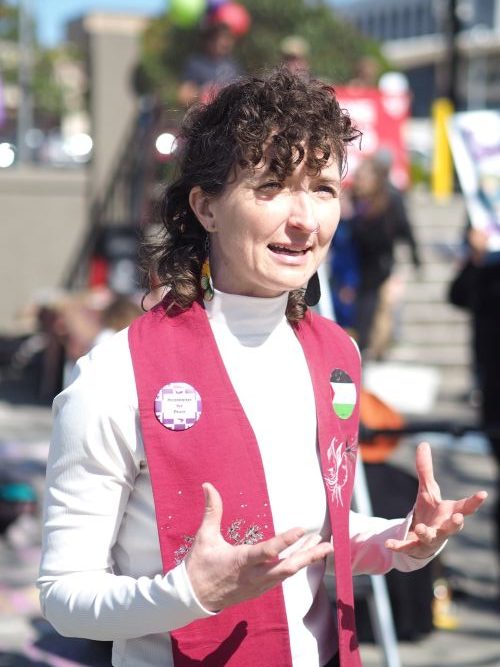
Joanna Lawrence Shenk. Photo by Randy Yee
This year my spouse and I practiced war tax resistance and redirection for the first time. We made this choice in large part due to the support from our congregation, First Mennonite Church of San Francisco. Over the last three years our congregation has been on a journey, discerning our corporate support for war tax resistance.
The conversation was catalyzed three years ago in the Outreach Committee of FMCSF as we wrestled with the egregiousness of our tax dollars funding the genocide in Gaza. One member of the committee was seriously considering tax resistance and was curious about how the congregation would respond. Would there be support for such a choice?
As a committee, we decided to bring this to the congregation in an explicit way. Through sermons, educational hour discussions, a small group, a congregational survey, a public forum and conversations at congregational meetings, we ended up drafting a congregational statement of support for those practicing war tax resistance and redirection.
We wrestled with the fact that we want to pay taxes. Taxes fund many important things in our society, including a social safety net, although now in tatters, that aids those who are dispossessed by our capitalist economic system. This choice is not tax evasion, since those who resist pay their withheld amount to an organization working to promote peace.
Our congregational statement went through multiple drafts and was unanimously approved on November 9, 2025. In conversation with Mennonite Action, we see our congregation as a pilot project for other congregations to consider. We believe that it is more powerful to have institutional support for war tax resisters who are public about their witness, than to do it solely as individuals.
As Mennonites seek to build a peace movement in this political moment, we need congregations who are courageous to stand in solidarity with war tax resisters. If the federal government chooses to come after us in a public way, they will be targeting congregations who have moral clarity in our long tradition of pacifism. This is a testimony to the world, no matter the outcome, and strengthens the resolve of others to take action in whatever ways they can. War tax resistance is one part of this movement for peace.
The congregational process and support at FMCSF gave my spouse and me the courage to send the following words to the IRS along with our tax payment this year:
Because the United States provides no legal way for pacifists to avoid supporting US militarism through its tax system, we are withholding this amount as an act of conscience. We do so this year with heavy hearts, as Israel continues its US funded onslaught on the people of Gaza despite a so-called ceasefire. Additionally, we are angered by the use of our tax dollars for the US and Israel’s war of aggression in Iran and the brutal bombings of Lebanon. The US government’s complicity in the genocide of the Palestinian people and this unlawful war in Iran underscores the moral and timely imperative of our tax resistance.We wanted to be clear in our letter that conscientious objection to the payment of taxes for war and the redistribution of such funds to humane alternatives represents a longstanding nonviolent tradition. As Mennonite Christians who practice nonviolence, we are grateful to stand with many other tax resisters who make this commitment in different ways. Our resistance was symbolic, as we withheld a relatively small amount of the taxes we owed.
We did not withhold this money with the assumption our action would change IRS policy, but rather by sharing publicly to inspire others to do the same. Mass movement is crucial to create systemic change.
We closed our letter with this explanation of where we redirected our withheld tax payment:
The $323 we are resisting and redirecting this year is the approximate amount we have been forced to pay for the war on Iran so far (as of April 10, 2026). For that amount in real time, visit irancost.com. We have redirected this same amount to the Beth Berry Memorial Peace & Justice Award fund. This fund honors the peacemaking work of high school seniors, seeking to bring an end to war and violence. We withhold and redirect this symbolic amount as a practice of our pacifist faith, and in prayer for an end to wars.
Editor Lincoln Rice
Production Rick BickhartMore Than a Paycheck: Refusing to Pay for War is a bimonthly publication of the National War Tax Resistance Coordinating Committee, a clearinghouse and resource center for the conscientious war tax resistance movement in the United States. NWTRCC is a coalition of local, regional and national affiliate groups working on war tax related issues.
NWTRCC sees poverty, racism, sexism, homophobia, economic exploitation, environmental destruction and militarization of law enforcement as integrally linked with the militarism which we abhor. Through the redirection of our tax dollars, NWTRCC members contribute directly to the struggle for peace and justice for all.
Paper Subscriptions are $25 per year. Digital subscriptions are free.
NWTRCC
P.O. Box 5616, Milwaukee, WI 53205
(800) 269‒7464
(262) 399‒8217
nwtrcc@nwtrcc.org
social media: socialmedia@nwtrcc.org
newsletter: wartaxresister@nwtrcc.org
www.nwtrcc.org - NWTRCC Gathering in Las Vegas November 6-8, 2026