





National War Tax Resistance Coordinating Committee
40 Years of Resistance
More Than a Paycheck,
REFUSING to PAY for WAR
Contents
-
-
- IRS Collection Efforts During Trump
By Lincoln Rice - Henry David Thoreau on Instagram
- Counseling Notes: Private Debt Collection Continues • Trouble Getting a Paper Refund
- Many Thanks to everyone who supports NWTRCC with their volunteer time or financial donations
- Network Updates
- War Tax Resistance News War Tax Resister Running for Congress
- NWTRCC and WTR Network News:
Mark Your Calendars for Next NWTRCC Conference!!! November 6-8, 2026 in Las Vegas, Nevada • In Memoriam – Don Timmerman - Book Review: My Tax Dollars: The Morality of Taxpaying in America
By Ruth Braunstein, Princeton University Press (2025,256 pp.) - War Tax Resistance Outreach WTR Session in Hamilton, New York • War Tax Resistance Event in Hardwick, Massachusetts
- Book Review An Urban Uprising: A Story of War Tax Resistance and Gardening
By Susan Van Haitsma
Click here to download a PDF of the August/September issue
IRS Collection Efforts During Trump
By Lincoln Rice
The IRS was already struggling with a deficit in staff and funds before the pandemic, but the pandemic accentuated these problems. They slowly recovered with extra funding and staffing during the Biden administration… only to suffer devastating cuts to staff and funding shortly after Trump took office for the second time.
The remaining IRS staff under Trump has been busy plugging holes while also implementing all the tax changes that were part of the Big Bad Bill from July 2025. Therefore, it should come as no surprise that IRS collection efforts have been minimal during the Trump administration.
The most common type of collection reported to the NWTRCC office is the levying of state income tax refunds. The IRS has a good relationship with state revenue offices, and this type of collection has been common in the past and continues to be common. If you currently have a federal income tax debt, it would be good to not overpay your state income tax during the year. This may mean needing to change your state income tax withholding with your employer so that you owe funds at the end of the year.
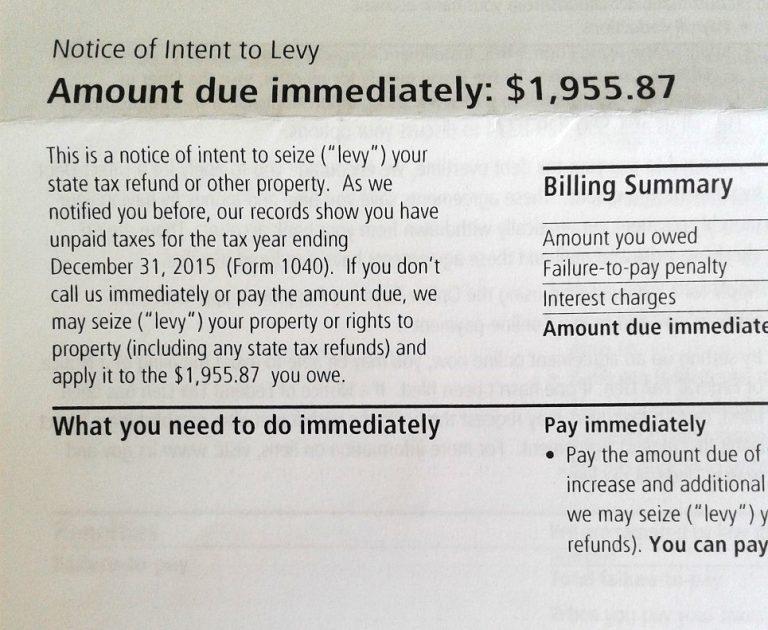
Since Trump began his second term, we also know of two instances of federal annuities having 15% of their monthly payments garnished. One garnishment began last summer and one this summer. Garnishing federal annuities was traditionally a less common way for the IRS to collect a tax debt, but perhaps the IRS will be leaning more into this practice in the future. Federal annuities are pensions for federal employees or military personnel. In both instances that we are aware of, the IRS garnished the federal annuity of the surviving spouse.
There was also a couple in the Midwest who had $850 levied from their bank account in May 2026. Thankfully, the IRS only levied their account for the first year of their resistance—tax year 2023. The couple owes around $9,000. It has been uncommon for the IRS to levy the bank of a household that owes less than $25,000. So this could either be a change in policy or represent an instance of the IRS deviating from the norm just to remind people that having less than a $25,000 tax debt does not mean that a bank account will not be levied.
Traditionally, it was almost automatic for the IRS to garnish 15% of someone’s Social Security if they had a tax debt, but they stopped this form of collection because of the pandemic and have not restarted it for most resisters. We only know of one resister who has had part of their Social Security levied since the pandemic. Since this is an extremely easy way for the IRS to start collecting on a tax debt, it is surprising it has not restarted en masse. If anyone does start having their Social Security garnished or faces any other type of IRS action, please call or email the NWTRCC office. It helps us keep new and longtime resisters abreast of current IRS trends.
Henry David Thoreau on Instagram

David Gross has created a fresh way for people to engage with Thoreau’s classic text, Civil Disobedience. As David Gross explains,
It presents the essay as though it were a social media thread and includes as “replies” many of the commentaries the essay has provoked over the decades, as well as Thoreau’s own elaborations of some of his themes.
David plans on adding “replies” as he finds more examples of people engaging thoughtfully with Civil Disobedience. You can find David’s creation at tinyurl.com/nh3t8bjv.
Counseling Notes
Purpose of this Section
This section serves as a hub for war tax resisters to keep abreast of the kind of actions the IRS is taking to collect federal tax debt. It also aids WTR Counselors, who are war tax resisters who volunteer to support existing and potential resisters. These counselors have undergone a day-long training to non-directively counsel individuals and aid them in determining their goals in regards to WTR, to discover the options most appropriate to their situation, and to assess realistically the possible consequences of those options. A current list of counselors by state can be found on the NWTRCC website (go to the “About Us” tab and click “Local Contacts & Counselors”). This training is usually offered once a year in February. If you would be interested in attending one of these trainings, please contact the NWTRCC office at nwtrcc@nwtrcc.org or (800) 269-7464.
Private Debt Collection Continues
We continue to hear from many longtime and newer war tax resisters that they are receiving IRS Notice CP40, “We assigned your overdue tax account to a private collection agency.”
Legislation back in 2015 forced the IRS to hire private collection agencies that began work in 2017. The main things to know:
- The IRS will give taxpayers written notice of accounts being transferred to a private collection agency (PCA). The agencies will send a separate letter to the taxpayer confirming this transfer. The initial contact will not be by telephone.
- Private collection agencies will identify themselves as contractors of the IRS and must follow the Fair Debt Collection Practices Act. To be sure it is not a scam, make sure the assignment is to one of these three IRS contractors: CBE, Waterloo, IA; Coast Professional, Inc., Geneseo, NY; ConServe, Fairport, NY.
- The PCAs have no power to collect money from you or levy salaries, bank accounts, etc. Their task is to convince you to clear your debt by sending money to the IRS. Whether the tactics are polite or border on harassment may depend on the individual collector.
- If you do not wish to work with or hear from the assigned PCA, you must put your request in writing to that agency. Then your case goes back to the IRS.
Trouble Getting a Paper Refund
We heard from a new resister who started holding back her estimated taxes in 2026 that she had issues receiving her refund due for her 2025 taxes. She did not provide her bank account info for direct deposit but was waiting for a paper check. The IRS has been transitioning away away from paper checks for a while, and this story confirms their effort to hassle people who want paper checks.
She states: “All their materials point you to a required sign in through ID.me which collects your ID numbers, selfies, etc. and links with your bank account. I didn’t want to give them all that information and got no help from their call lines or my accountant. So I made an appointment to go to the IRS in person. This was surprisingly easy to do—just a few days’ wait.
“In person, they looked at my ID, verified my address, then asked if I was unable to access my IRS account online. I answered yes, since you can’t access your account without going through ID.me. So he filled out the forms to send me a check in the mail. It all went smoothly (aside from that it took him half an hour to do the paperwork.)”We thought we would share this in case anyone else is having issues with receiving a refund from the IRS.
[Editor’s Note: If you can wait three months for your refund, the IRS will send a paper check about ten weeks after you receive Notice CP53E, which you should ignore. This notice asks you to provide your bank account information.]
Many Thanks
Thanks to each of you who has donated for the May Appeal 2026! Remember, you can also donate online through PayPal and Venmo (not tax deductible) or Resist (tax deductible) by clicking on the “Donate” button at nwtrcc@nwtrcc.org. (Please let the NWTRCC office know if you use Resist.) It’s never too late to send that contribution to support our work.
We are very grateful to these alternative funds and WTR groups for their redirections and Affiliate dues:
Community Peacemaker Teams, War Tax Resistance Penalty Fund; St. Lawrence Catholic Worker (Kansas City, Kansas)
Network Updates
The Network List of Affiliates, Area Contacts, Counselors, and Alternative Funds is updated and online at nwtrcc.org, or contact the NWTRCC office (nwtrcc@nwtrcc.org or (800) 269-7464), if you would like a printed list by mail.
Don’t forget, you can find us on
Facebook • Twitter • YouTube • Instagram •
or join our discussion listserve.
Click on the icons at nwtrcc.orgAdvertise to Activists! See the advertising rates for this newsletter or contact the editor at (800) 269‒7464.
Consider a Bequest
NWTRCC accepts bequests which can be arranged through your will or other estate plan.
Don’t Delay, Make a Bequest to NWTRCC Today!
Many of us war tax resisters (WTRs) are getting on in age though we don’t like to admit it and some of us are still young but want to ensure the longevity of NWTRCC. We have been supporters of NWTRCC with our dollars and our efforts and understand the importance of ensuring that NWTRCC is around as long as our taxes support death, destruction, and the military-industrial complex. NWTRCC is key to keeping WTRs connected across the country and the globe. It provides critical information for potential, new and long-time WTRs through this newsletter, the practicals, counselors, staff, and other technical support. Through national gatherings, social and traditional media, and its presence at peace and justice events across the country, the organization promotes outreach to the community at large to raise awareness that WTR is a way to resist collusion with the killing of citizens here and abroad.
A charitable bequest is the easiest and best way to make a gift to NWTRCC. Through your will or other estate plan and no matter what your age is, you simply name NWTRCC as the beneficiary of a portion of your estate or of particular assets in your estate. Bequests can be some of the most enduring gifts. A large or small bequest can be made for many reasons. It can honor a loved one while providing critical support to NWTRCC to maintain or expand the committee’s work. A bequest costs nothing now yet it may give you great satisfaction to know that your gift will live on in NWTRCC. You can find more information about making a bequest on our website: nwtrcc.org/bequests. You can also contact Lincoln Rice at (800) 269-7464 to discuss gift strategies that can help you support NWTRCC and WTR.More information: nwtrcc.org/bequests, (800) 269-7464, or nwtrcc@nwtrcc.org.
“I have been donating quarterly to NWTRCC for many years, because as a life-long war tax resister I feel I definitely need NWTRCC to be there and to be strong.”
— Becky Pierce, Dorchester, Mass.
Please join Becky as an annual, monthly, or quarterly pledger to NWTRCC. See the donate page on our website to pledge through Paypal (any amount monthly) or through Resist (monthly, quarterly, and annual options). If you would like a pledge packet to give by check, please contact the NWTRCC office, 800-269-7464.
Are you organizing an action, training, or gathering?
Got a good photo of your war tax resister community in action?
Keep us in the loopWe’re all about building the community of resisters.
We’d love to celebrate you + help spread the word. Email Chrissy Kirchhoefer (Our Outreach Consultant):outreach@nwtrcc.orgDonate by Venmo

NWTRCC now accepts donations by Venmo! We still accept donations by check, PayPal, and credit/debit card using PayPal. Also, tax deductible donations can be made by check or credit/debit card using one of our fiscal sponsors. For more information on all the ways you can donate to NWTRCC, go to nwtrcc.org/donate.
War Tax Resistance News
War Tax Resister Running for Congress
[Editor’s Note: NWTRCC does not endorse any political party, but we do report and share about war tax resistance. We recently had a conversation with Kymone Freeman, who is the Green Party candidate running for the US House Non-Voting Delegate for the District of Columbia.]
Kymone Freeman, I see that you have been a war tax resister for the past 30 years. It’s often a specific war that brings someone to war tax resistance. How did you become a war tax resister?

Photo courtesy of freeman4Congress
I have always been against war. My father was a Marine and after being shot in the face in Vietnam, losing an ear and half of his hearing, I was forbidden to ever join the military. He was the first to teach me about Muhammad Ali’s anti-war stance. So you could say it all began with the Vietnam War. But it wasn’t until the Gulf War under George H. Bush that I openly began to wonder: How do you stop a war? Being from Washington, DC, I have attended countless marches and protests and haven’t yet seen one put an end to a war. The fascist Alexander Haig was right, “You can march all you want as long as you continue to pay your taxes.” I was first introduced to that quote when I met the late great criminal defense attorney and civil rights advocate, Johnnie Cochran, in 1996 and that’s when I became an actual war tax resister. He was the first to point out to me that “the best way to air your grievances with the federal government was by withholding income taxes.”
Why have you stayed a war tax resister all these years and have there been any repercussions?
When I met Johnnie Cochran during a book signing, I told him how much his words inspired me and that I planned to follow them. He then gave me his card and personal number. When he handed it to me, he didn’t let it go when I attempted to accept it. With both of our hands holding the same card simultaneously, he looked me directly in the eye and told me, “You will have to give me your word that you will go the distance.” Meaning, I wouldn’t get scared if the IRS contacted me or if I caught a case and accepted some sort of plea bargain like over 90% of all criminal cases do in the American judicial system. I gave him my word that I would stay the course. He gave me his word that he would represent me if need be and directed me to call him if the IRS ever prosecuted me. The IRS never did and less than 9 years later, he was gone.
The only repercussions I have experienced as a war tax resister were the initial threatening letters from the IRS for the first 3-4 years. After that, the letters stopped coming. It’s important to point out that I only worked as a salaried employee at the US Postal Service for about 7 years with no federal or state taxes ( is not a State) being withheld. Since that time, I have been working for myself and only receive 1099s. The main problem I’ve faced as a war tax resister is the inability to get direct funding from the US government due to their Clean Hands Certificate, which requires tax clearance. But by incorporating a business, I am able to circumvent the system. Also, during most of my 30 years of resistance and refusal to file, I have been largely silent. Now, that Trump has openly said that the federal government has no obligation to provide social services to the American people, only a strong War Department with a trillion-dollar budget that isn’t subjected to audit, I feel emboldened to openly declare to the world that War Tax Resistance is the only peaceful revolution possible to rein in this rogue, authoritarian regime.
You are running as the Green Party candidate for the US House Non-Voting Delegate for the District of Columbia and are advocating nonpayment of federal income taxes by DC residents until the DC delegate becomes a voting member of Congress DC delegate becomes a voting member of Congress. Would I be correct in assuming that your own war tax resistance has fueled your idea to promote tax resistance among Washington, DC residents? Please share how this tax resistance campaign came to be?
In DC, the Green Party is known as the DC Statehood Party. And yes, my history of war tax resistance has led to my promotion of tax resistance among DC residents. Educating the over half a million disenfranchised voters about the fact that DC is the ONLY US Territory that pays federal taxes and pays more per capita than anyone else in the country provides the perfect segue to the macro issue of tax resistance that this country was founded on.
Since launching my campaign on April 4th, the anniversary of MLK’s government assassination in 1968 and his anti-war speech in 1967, the calls for tax resistance have grown louder and are quickly becoming more popular in the nation’s capital. My campaign t-shirt even states it plainly: Should DC Pay Federal Income Taxes? We will continue to push tax resistance into the mainstream until the general elections in November as an end to taxation without representation and the only peaceful end to war. Join us. freeman4congress.com
NWTRCC and WTR News
Mark Your Calendars for Next NWTRCC Conference!!! November 6-8, 2026 in Las Vegas, Nevada
NWTRCC will be hosted by the Las Vegas Catholic Worker for its conference the first full weekend of November. We are working on the agenda and would gladly accept session proposals. Registration information for those attending in person and online is already up on the website. Go to the “Programs” tab on the website and click on “Gatherings and Events.”
In Memoriam – Don Timmerman
By Lincoln Rice
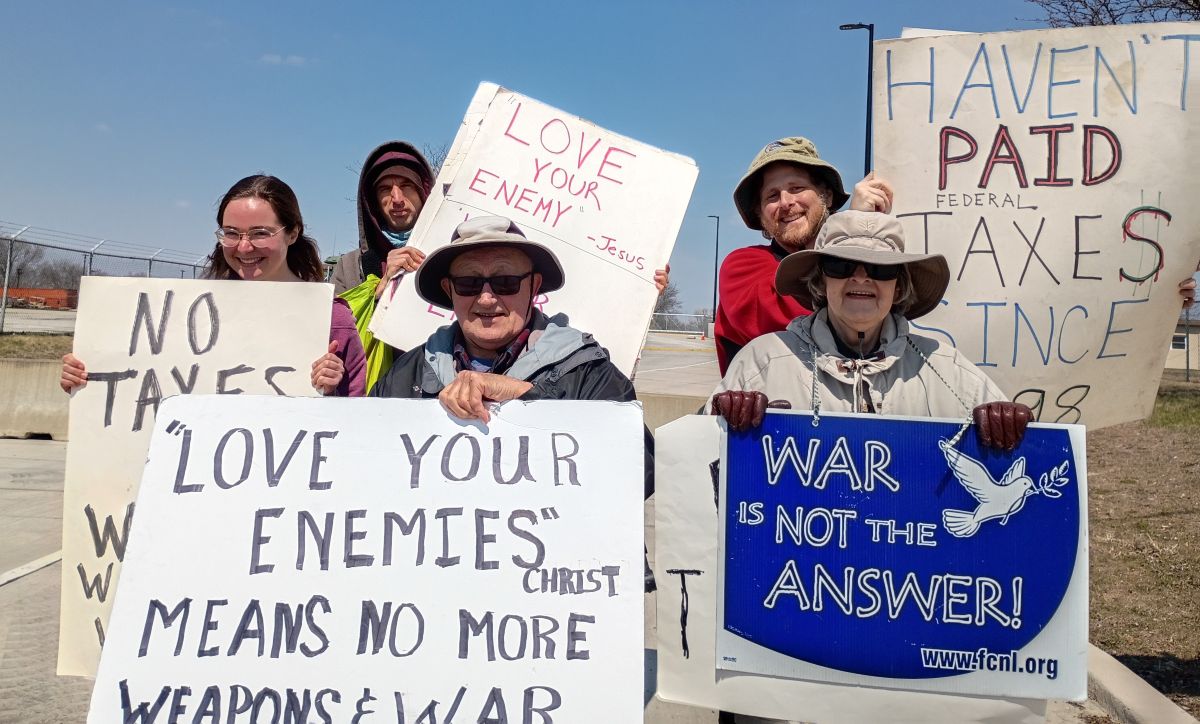
Don Timmerman (front left) with his wife Roberta Thurstin (front right), surrounded by Casa Maria Catholic Workers at the Tax Day 2025 protest in front of the Army Reserve.
Photo courtesy of Milwaukee War Tax Resistance.On the morning of July 19, 2026, Don Timmerman passed away at home surrounded by his family. I don’t exactly know when Don became a war tax resister, but it was well before I met him in 1998. Don was raised on a farm in Dickeyville, Wisconsin before attending Marquette University and eventually serving as a Catholic priest in Tanzania. While visiting Wisconsin in 1974, he was advised to visit the Casa Maria Catholic Worker in Milwaukee and never left. Over the decades, he became synonymous with Casa Maria and for his promotion of peace and justice.
Don was one of the founders of Milwaukee War Tax Resistance. This group sponsored an annual protest at the IRS office in the “Blue” federal building in downtown Milwaukee. After protesting for an hour, Don and others would enter the building to protest at the IRS office and were usually arrested en route. My first arrest was with Don en route to the IRS office on Tax Day 1999.
Don lived simply and was not well versed in the how-to’s of war tax resistance. That was okay with me because he placed the WTR Guidebook and all NWTRCC’s practicals on the Casa Maria bookshelf. He had also invited NWTRCC to hold its gathering in Milwaukee in November 1999. Without this introduction to NWTRCC, I would not have served on AdComm shortly afterward and probably would never have become NWTRCC’s Coordinator. So I owe a lot to Don.
Don was involved in countless campaigns for peace and justice over the decades, but war tax resistance was close to his heart. It was rare for him to give an interview or a speech without mentioning war tax resistance. His war tax resistance was rooted in a vision of the nonviolent Jesus. Don believed that if one genuinely believes in nonviolence, it was a simple and logical conclusion that you cannot pay for war.
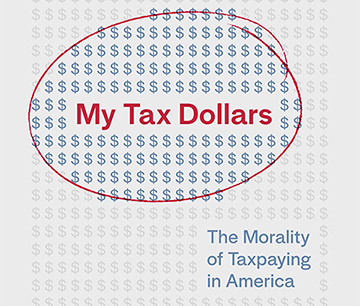
Book Review: My Tax Dollars: The Morality of Taxpaying in America
By Ruth Braunstein, Princeton University Press (2025, 256 pp.)
By Ruth BennI quite enjoyed the YouTube video of Johnny Cash singing “After Taxes” with an amused air while he laments all the things he won’t be able to afford after the IRS takes its cut from his paycheck. Johnny Paycheck’s “Me and the IRS” takes a more serious tone over the economic inequality of taxpaying singing,
Now if everybody kicked in his fair share I might back up and say yes
But the big man plays while the little man pays so to hell with the IRS
Thus, one is led to good entertainment in Ruth Braunstein’s sociological dive into the culture of taxpaying. It’s also amusing to realize that as war tax resisters we are being studied and analyzed. Our motivations are parsed and compared to others who have moral objections to how taxes are used or who object to the whole system of taxation as imposed by the federal government.
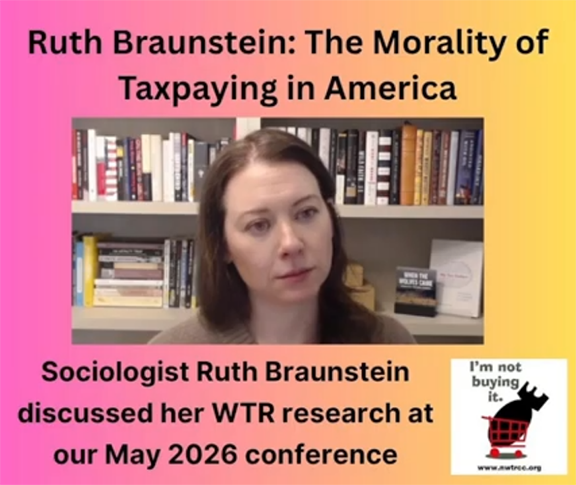
Braunstein is an associate professor of sociology at the University of Connecticut, and her book is written as an academic study, so she was attentive to methodology and sources. She carried out interviews in person or by phone; visited archives, including the peace archive at Swarthmore College where she read hundreds of “our” letters to the IRS; collected pop culture tax-related artifacts; attended workshops like those sponsored by libertarian tax protesters, etc. Her section on the “tax honesty” movement embodied by Irwin Schiff and followed by Peter Hendrickson provides useful information for the war tax resistance network. It’s helpful to understand some of the anti-tax arguments to clarify distinct approaches in WTR counseling sessions or talking to the media.
Braunstein’s research took a number of years, including through the first Trump presidency but not into the most recent surge in tax resistance related to Gaza and Trump II. She began by talking to activists (war tax resisters/conscientious objectors, anti-abortion campaigners, and anti-government protesters) “because these people are unusually morally articulate.” Activists spend a lot of time thinking about taxes and what their tax dollars are doing. The more mainstream taxpayer may share some of these views but tends to accept taxpaying as a task that must be done whether they agree with the details or not.
Most of us grew up having absorbed the message that “you have to pay your taxes,” and the book covers the various forms of government propaganda promoting taxpaying as part of “being a good citizen.” That message was particularly strong during WWII featuring a Donald Duck cartoon. The post-war need for new messaging led to those ubiquitous highway signs declaring “Your Taxes at Work” among other efforts.
Ruth Braunstein isn’t looking to argue a particular point in My Tax Dollars. She’s searching out motivations behind taxpaying in this “voluntary” tax system of the US government. She has a strong curiosity toward the vocal minorities who see taxes and taxpaying as sacred or profane, especially those who imagine their actual dollars being used in ways they find deeply distressing. She found that this seriousness about tax dollars, especially among antiwar activists, often extended to a desire to avoid as many “profane” uses of their money as possible. She carried out long interviews with war tax resisters Paul and Fran Sheldon and Christian activist Shane Claiborne, highlighting their evolution to simple lifestyles to better control the uses of their money.
Braunstein notes the success of anti-abortion activists in getting the government to chip away at any possible tax funding for abortions, not through tax resistance but insistent lobbying. War tax resisters face a bigger obstacle given the wide acceptance of so-called “defense” funding. The book has only a mere mention of the decades long legislative campaign for a Peace Tax Fund bill and might have benefited from some attention to the 2014 Hobby Lobby decision by the Supreme Court that allowed for an accommodation for companies that did not want abortion included in their Obamacare policies but specifically stated that there was no similar “least restrictive” option for those who don’t want their money going to war. This decision underscores once again Randolph Bourne’s statement that “war is the health of the state.”
Ruth Braunstein discussed her book with attendees at the last NWTRCC gathering, and you can hear her talk on NWTRCC’s YouTube channel, but that’s no substitute for reading her quite readable book. You’ll meet many of the activists still active with NWTRCC and be led down the rabbit hole chasing her references to songs or books or other interesting aspects of taxes and taxpaying.
[Ruth Benn is a former NWTRCC Coordinator and active with NYC War Resisters League.]
War Tax Resistance Outreach

Pam Allee hosting a Penny Poll at the Make America Fair event in June in Portland, Oregon.
WTR Session in Hamilton, New York
By Tom Joyce
On June 29th, 2026, in Hamilton, New York, a group of people was convened to learn about and explore the possibility of individual and/or group war tax resistance. Thirteen people attended. Thomas Joyce shared about his history of war tax witness: how he has done it; the consequences; and the rewards of following his conscience. He reviewed the ways and means that people resist paying taxes. Controlling the withholding of taxes in the first place is one of the keys to being able to decide whether or not to pay, and if so, how much.
In an initial sharing of questions, ideas, and fears and concerns; people shared:- Is there a critical mass needed to affect change?
- What are the risks and penalties of refusing to pay taxes?
- I have appreciated taxes and their use, but now I can see that the money is needed elsewhere from where it is going.
- How can I do this given my current circumstances?</li.
- There is clearly a misuse of our common funds.
- How can we help others in the process?
- Our taxes are being used to support the genocide in Gaza.
- I have been under a taxable income previously, but now I am not.
During the discussion about what we can do, some in the group shared what they are considering and what questions they had. There was interest in learning more about the Peace Tax Fund legislation and several people talked about researching it. People wanted to learn if there is a current sponsor; how many legislators have supported it in the past; and details about how it would work, if enacted.
There was a proposal for us to control the withholding process as a mechanism to make the political point: You, the government, are not going to use our money free of charge for the coming year to do things we oppose.
We discussed in more detail the consequences of tax resistance, which is illegal, as was mentioned on numerous occasions. Because the IRS is so underfunded and for other political reasons there is little enforcement currently against tax resisters. Predominantly, tax resisters receive a series of letters demanding payment of unpaid taxes, which include increasing penalties and interest. There are also threats of liens on property, which are sometimes filed.
A number of ideas were talked about to test our beliefs:- Refuse to pay some amount and decide to pay after IRS letters start to arrive if it becomes too nerve wracking.
- Pay, but include a letter of protest.
- Refuse a portion of the tax and donate it to where we want our tax money to go.
- Tom explained how the Quakers’ escrow account works and invited people to consider using that method. That way, if a resister is collected on by the IRS, the money is available for them to be reimbursed. (It would not cover the penalties and interest, just the amount that was actually deposited.)
Tom offered his availability to talk with anyone about their individual circumstances, their concerns, and the process for making decisions.
War Tax Resistance Event in Hardwick, Massachusetts
The Agape Community in Hardwick, Massachusetts will be hosting its annual St. Francis Day event on Saturday October 3rd, 2026. The day will feature a discussion on war tax resistance as well as a session with Shane Claiborne of Red Letter Christians, who is himself a war tax resister. For more information, contact the Agape Community at peace@agapecommunity.org.
Book Review:
An Urban Uprising: A Story of War Tax Resistance & Gardening
By Susan Van Haitsma

Do war tax resistance and gardening often go together? In my observation, yes! Many of the people I’ve met through NWTRCC over the years have cultivated not only peace and justice with their life work—they have cultivated the soil, too. Longtime war tax resister, Clare Hanrahan, is one such “avant-gardener,” as she puts it, and she has just published a timely book, An Urban Uprising, describing the Elder & Sage Community Gardens project in Asheville, North Carolina, that she co-founded and has co-managed over the last ten years.I got to know Clare in the early 1990s when we co-wrote the first version of NWTRCC’s WTR Practical series pamphlet, “Simple Living as War Tax Resistance.” In addition to other journalism work, Clare wrote and published “Jailed for Justice” in 2002 about her six-month sentence in the Alderson, West Virginia federal women’s prison camp after crossing the line at the School of the Americas, and her family-based memoir, The Half Life of a Free Radical in 2016.
Clare worked in the prison greenhouse while she was at Alderson, earning a certificate in horticulture. And, as she explains in her new book’s preface, “I learned so much more than horticulture in prison. I found common ground living and working among people with varied levels of education, emotional maturity, mental health, and physical ability, as well as ethnic, racial and cultural diversity. It is much like the work of tending to a garden with all its complex biodiversity and competitive adaptations for survival in an ecosystem long out of balance.”
As a war tax resister living in a popular tourist city like Asheville, Clare has worked to find affordable living situations, often exchanging labor for rent. In 2011, she moved into a downtown apartment building for low-income elders and persons with disabilities. The building, a stately former hotel, adjoined a vacant gravel lot, and that is where Clare and other apartment dwellers saw possibility. They began by planting seeds here and there in cracks and crevices along the streets in their urban core. Then, they envisioned a block-sized community garden in the gravel lot that, due to city regulation, would have to be entirely container-grown.
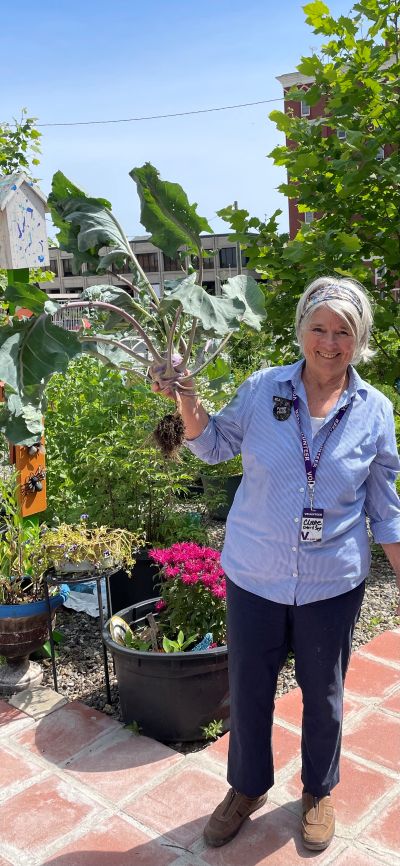
Clare Hanrahan at Elder and Sage Community Gardens
Step by step, they gathered community support, worked through city permitting processes and created an organizational structure of completely volunteer management. On June 1, 2017, Elder & Sage Community Gardens was officially inaugurated, and over the years since, it has flourished, becoming a colorful, welcoming space that is now a tourist destination in itself.With wisdom, warmth and humor, too, Clare documented the joys and challenges that arose as the gardens took shape. Gardeners dealt with issues related to security, maintenance, financing, tools, weather, water, aesthetics, garden “pests” (including, once, a bear!) and balancing one another’s sometimes strong gardening opinions. As a community gardener myself in central Austin, Texas, I could relate to each story on every page and the problem-solving that needed to be done. Well—except for the bear.
I especially like how Clare names throughout her book the many volunteers with whom she has worked and the tasks they have done. She also lists, using both common and Latin names, the many kinds of flowers, vegetables and herbs that gardeners have planted over the years, further illustrating how the beautiful variety in the gardens reflect the beautiful variety of people who’ve created Elder & Sage and who visit it.
The power of Clare’s book, to me, is that Elder & Sage provides an example for us all. If an ever-evolving, volunteer group of elders can, together, create a healthy green oasis out of a downtown gravel lot starting with almost nothing, there is really no end to what human beings can do to enliven our urban spaces.
As war tax resisters, we stand against destructive forces in our world. We also put our efforts into growing the alternative: the community garden that, as a human family on this bountiful earth, we all essentially are.
An Urban Uprising can be ordered through Celtic Wordcraft Books at www.celticwordcraftavl.wordpress.com.
Editor Lincoln Rice
Production Rick BickhartMore Than a Paycheck: Refusing to Pay for War is a bimonthly publication of the National War Tax Resistance Coordinating Committee, a clearinghouse and resource center for the conscientious war tax resistance movement in the United States. NWTRCC is a coalition of local, regional and national affiliate groups working on war tax related issues.
NWTRCC sees poverty, racism, sexism, homophobia, economic exploitation, environmental destruction and militarization of law enforcement as integrally linked with the militarism which we abhor. Through the redirection of our tax dollars, NWTRCC members contribute directly to the struggle for peace and justice for all.
Paper Subscriptions are $25 per year. Digital subscriptions are free.
NWTRCC
P.O. Box 5616, Milwaukee, WI 53205
(800) 269‒7464
(262) 399‒8217
nwtrcc@nwtrcc.org
social media: socialmedia@nwtrcc.org
newsletter: wartaxresister@nwtrcc.org
www.nwtrcc.org - IRS Collection Efforts During Trump
-