






IRS Building in Washington D.C. Photo courtesy of Joshua Doubek on Wikimedia Commons
The IRS was already struggling with a deficit in staff and funds before the pandemic, but the pandemic accentuated these problems. They slowly recovered with extra funding and staffing during the Biden administration… only to suffer devastating cuts to staff and funding shortly after Trump took office for the second time.
The remaining IRS staff under Trump has been busy plugging holes while also implementing all the tax changes that were part of the Big Bad Bill from July 2025. Therefore, it should come as no surprise that IRS collection efforts have been minimal during the Trump administration.
The most common type of collection that has been reported to the NWTRCC office is the levying of state income tax refunds. The IRS has a good relationship with state revenue offices, and this type of collection has been common in the past and continues to be common. If you currently have a federal income tax debt, it would be good to not overpay your state income tax during the year. This may mean needing to change your state income tax withholding with your employer so that you owe funds at the end of the year.
Since Trump began his second term, we also know of two instances of federal annuities having 15% of their monthly payments garnished. One garnishment began last summer and one this summer. Garnishing federal annuities was traditionally a less common way for the IRS to collect a tax debt, but perhaps the IRS will be leaning more into this practice in the future. Federal annuities are pensions for federal employees or military personnel. In both instances that we are aware of, the IRS garnished the federal annuity of the surviving spouse.
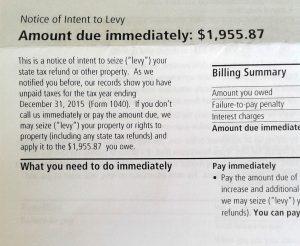
Notice of Intent to Levy, Notice CP504. This is the final notice before the IRS may take enforcement action. It does not mean that a levy will happen.
There was a couple in the Midwest who had $850 levied from their bank account in May 2026. Thankfully, the IRS only levied their account for the first year of their resistance, tax year 2023. The couple owes around $9,000. It has been uncommon for the IRS to levy the bank of a household that owes less than $25,000. So this could either be a change in policy or represent an instance of the IRS deviating from the norm just to remind people that having less than a $25,000 tax debt does not mean that a bank account will not be levied.
Traditionally, it was almost automatic for the IRS to garnish 15% of someone’s Social Security if they had a tax debt, but they stopped this form of collection because of the pandemic and have not restarted it… yet. Since this is a very easy way for the IRS to start collecting on a tax debt, it is surprising that it has not restarted. If anyone does start having their Social Security garnished or faces any other type of IRS action, please call or email the NWTRCC office. It helps us keep new and longtime resisters abreast of current IRS trends.
~Post by Lincoln
I am coming to the 10 year limit on each of my three years of massive Resistance of 2016, 2017 and 2018 federal income taxes. I got my annual reminder letters last week and the total due is about $450,000. So it will definitely get to about a half $1 million by the conclusion of the 10 years. No way the IRS is going to collect all of that so the only question is are they going to do anything as the collection period draws to an end. They took money from my Social Security some years ago, but haven’t recently. They took some money when I had mandatory withholding from some retirement accounts. But my only asset at the moment is my condominium and seizing a condominium is probably pretty complicated! I really haven’t done anything recently to poke the bear and don’t have any ideas about doing anything in the near future other than continuing to tell anybody and everybody about my experience.
A couple of years ago, my state refunded my over payment of state taxes. The next year they sent it to the feds, so last year I did not file to get it back. Better that it pay for state expenses than the military…although I’m sure there are military expenses hidden in our state budget. Anyway, at least the Pentagon is not getting it directly.
I have received my first notice of past due taxes in my first year of War Tax Resistance. I responded by lengthening and resending the initial letter announcing my intent and rationale for War tax resisting. I intend to continue to add to that letter and resend the infinitely longer declaration, with every new atrocity committed by the government and its proxies, in response to every request for federal tax payment.
As I told the IRS you can’t squeeze water from a stone. But I can and will throw that very stone, glass house or no, in the face of injustice.
Nissa, Thank you for your comment and work for peace! Just one word of caution when interacting with the IRS. You didn’t mention that you were appealing anything, but just in case, you probably do not want to appeal. That starts an official IRS process where you could be assessed a $5,000 frivolous fine for using arguments in the appeals process that have already been deemed frivolous.