





Book Review
My Tax Dollars: The Morality of Taxpaying In America
By Ruth Braunstein, Princeton University Press (2025, 256 pp.)
I quite enjoyed the YouTube video of Johnny Cash singing “After Taxes” with an amused air while he laments all the things he won’t be able to afford after the IRS takes its cut from his paycheck. Johnny Paycheck’s “Me and the I.R.S.” takes a more serious tone over the economic inequality of taxpaying singing,
“Now if everybody kicked in his fair share I might back up and say yes
But the big man plays while the little man pays so to hell with the IRS”
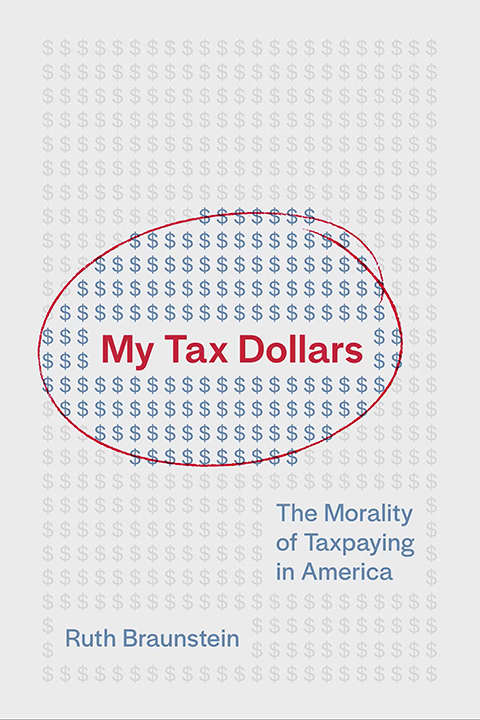 Thus one is led to good entertainment in Ruth Braunstein’s sociological dive into the culture of taxpaying. It’s also amusing to realize that as war tax resisters we are being studied and analyzed. Our motivations are parsed and compared to others who have moral objections to how taxes are used or who object to the whole system of taxation as imposed by the federal government.
Braunstein is an associate professor of sociology at the University of Connecticut, and her book is written as an academic study, so she was attentive to methodology and sources. She carried out interviews in person or by phone; visited archives, including the peace archive at Swarthmore College where she read hundreds of “our” letters to the IRS; collected pop culture tax-related artifacts; attended workshops like those sponsored by libertarian tax protesters, etc. Her section on the “tax honesty” movement embodied by Irwin Schiff and followed by Peter Hendrickson provides useful information for the war tax resistance network. It’s helpful to understand some of the anti-tax arguments in order to clarify distinct approaches in WTR counseling sessions or talking to the media.
Braunstein’s research took a number of years, including through the first Trump presidency but not into the most recent surge in tax resistance related to Gaza and Trump II. She began by talking to activists (war tax resisters/conscientious objectors, anti-abortion campaigners, and anti-government protesters) “because these people are unusually morally articulate.” Activists spend a lot of time thinking about taxes and what their tax dollars are doing. The more mainstream taxpayer may share some of these views but tends to accept taxpaying as a task that must be done whether they agree with the details or not.
Most of us grew up having absorbed the message that “you have to pay your taxes,” and the book covers the various forms of government propaganda promoting taxpaying as part of “being a good citizen.” That message was particularly strong during WWII featuring a Donald Duck cartoon. The post-war need for new messaging led to those ubiquitous highway signs declaring “Your Taxes At Work” among other efforts.
Ruth Braunstein isn’t looking to argue a particular point in My Tax Dollars. She’s searching out motivations behind taxpaying in this “voluntary” tax system of the U.S. government. She has a strong curiosity toward the vocal minorities who see taxes and taxpaying as sacred or profane, especially those who imagine their actual dollars being used in ways they find deeply distressing. She found that this seriousness about tax dollars, especially among antiwar activists, often extended to a desire to avoid as many “profane” uses of their money as possible. She carried out long interviews with war tax resisters Paul and Fran Sheldon and Christian activist Shane Claiborne, highlighting their evolution to simple lifestyles to better control the uses of their money.
Braunstein notes the success of anti-abortion activists in getting the government to chip away at any possible tax funding for abortions, not through tax resistance but insistent lobbying. War tax resisters face a bigger obstacle given the wide acceptance of so called “defense” funding. The book has only a mere mention of the decades long legislative campaign for a Peace Tax Fund bill and might have benefited from some attention to the 2014 Hobby Lobby decision by the Supreme Court that allowed for an accommodation for companies that did not want abortion included in their Obamacare policies but specifically stated that there was no similar “least restrictive” option for those who don’t want their money going to war. This decision underscores once again Randolph Bourne’s statement that “war is the health of the state.”
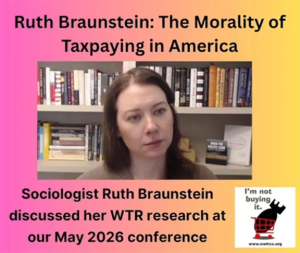 Ruth Braunstein discussed her book with attendees at the last NWTRCC gathering, and you can hear her talk on NWTRCC’s YouTube channel, but that’s no substitute for reading her quite readable book. You’ll meet many of the activists still active with NWTRCC and be led down the rabbit hole chasing her references to songs or books or other interesting aspects of taxes and taxpaying.
By Ruth Benn, former NWTRCC Coordinator, WTR counselor,
and active with NYC War Resisters League.
I just got this book from the library and can’t wait to read it! Thank you, Ruth Benn for your synopsis of the book!😄✌🏼
Great that the library has it!
https://youtu.be/fAJfDP3b5_U
Tupac: “we got money for wars but can’t feed the poor.”