






Christina from National Tax Strike brought M&Ms to our meeting with messages geared to our crowd. Photo by Lincoln Rice.
For the first time in two years, we held our twice-yearly war tax resistance conference in person. We are very thankful to Patricia Kirkpatrick, an AdComm member in Worcester, who was a local organizer and hosted several attendees in her family’s home. Our conference events on Friday and Saturday were held at the Worcester Friends Meeting House. Most of the sessions were also streamed on Zoom.
Rep. Jim McGovern and Peace Tax Fund Legislation
Friday evening featured two different speakers. At 6:00 pm, US Representative Jim McGovern joined us. Since the passing of Representative John Lewis, McGovern has been the primary sponsor of the National Campaign for a Peace Tax Fund, which guarantees that federal tax monies paid by conscientious objectors would be diverted from military spending to other government programs. One of the reasons McGovern was able to join us was due to the government shutdown, which was still occurring when we met.
Much of what McGovern shared was Democratic rhetoric, but regarding the Peace Tax Fund, he shared he was planning on reintroducing that legislation and that he would let us know when a date is firmed up. He noted that the legislation would allow taxpayers to divert their tax monies from nuclear weapons and the genocide in Gaza. He continued that the legislation had an “uphill battle” with detractors on the right and left. For example, he also informed us that some progressive representatives opposed the bill for fear that it could be used by anti-abortion activists for their cause.
National Priorities Project
Lindsay Koshgarian, the Program Director for the National Priorities Project (nationalpriorities.org) offered critical information about the national budget and the budget-making process. National Priorities Project is the only nonprofit, non-partisan federal budget research organization in the nation with the mission of making the federal budget accessible to the American public.
Lindsay noted that when the numbers are adjusted for inflation, we have never returned to the high military expenditures of World War II, with the caveat that we are nearing that threshold and will likely pass it with the next federal budget. She also noted that the Big Terrible Bill passed in July included an additional $153 billion for military spending, including $24 billion for Trump’s missile defense system, which is just a small down payment. To help pay for all this, she noted several budget cuts, including drastic cuts to food stamps that will go into effect following the midterm elections in November 2026.
Planning for Tax Resistance in Tax Season 2026
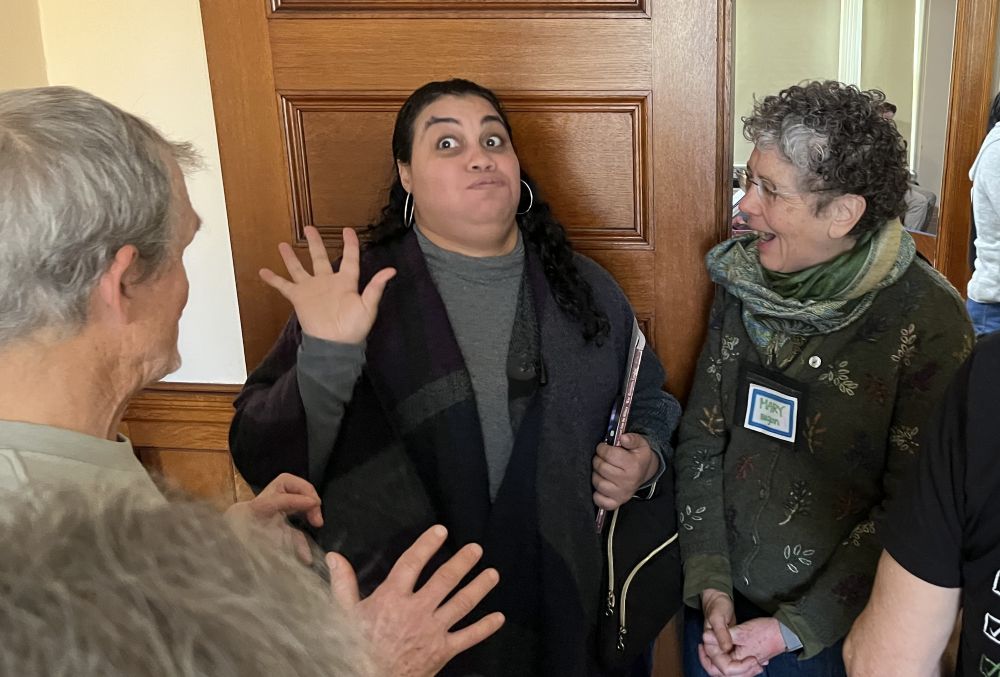
Lively Discussion during a break in the conference with Daniel Woodham (left), Virginia Cuello of The Black Response Cambridge (center), and Mary Regan of New England War Tax Resistance (right). Photo by Paula Rogge
On Saturday morning, NWTRCC Outreach Consultant Chrissy Kirchhoefer facilitated a workshop on planning for Tax Season 2026. After sharing several NWTRCC resources, we broke out into smaller groups to generate ideas to enhance war tax resistance outreach this coming tax season. Ideas included: bring NWTRCC flyers to protests, promote a spectrum of war tax resistance, host a monthly book study with the updated WTR guide book, post short videos with war tax resisters, include brass bands, puppets, and actual pies at Tax Day gatherings, incorporate local affected groups, promote slow tax resistance (filing paper, in-person payments, etc.), pass out War Resisters League pie charts on Pie Day (March 14), offer penny polls, create a Tax Day playlist to use at gatherings.
After lunch, we continued with a Resistance Panel. Virginia Cuello shared about the work of The Black Response Cambridge (theblackresponsecambridge.com). Claire Schaeffer-Duffy, the Program Director for the Center for Nonviolent Solutions (nonviolentsolutions.org) and a member of the Ss. Francis and Therese Catholic Worker, discussed the genocide in Palestine. Paul Popinchalk, a 350.org member and retired engineer with experience in facilities management and energy conservation, spoke to increasing concern of the federal budget’s impact on the environment during the Trump administration.
Trends in War Tax Resistance
The following session featured Ruth Benn, one of the authors of the recently updated book War Tax Resistance: A Guide to Withholding Your Support from the Military, and Christina Thompson, the Coordinator for the National Tax Strike (taxstrike.info). Ruth spoke to changes in the war tax resistance landscape since the publishing of the previous 2003 edition of the Guide. This included NWTRCC’s success in stopping the wrongly enforced $5,000 frivolous fine for some resisters who included a letter with their resistance as well as impact of the Tea Party in defunding the IRS.
Christina discussed how the National Tax Strike formed in the early days of the Trump Administration because of the “constitutional crisis.” She also stated that her organization formed as “a direct result of NWTRCC’s work.” Since then, they have hosted war tax resistance sessions with their own membership, as well as for other groups, such as Free DC.

Charlie King gave a concert on Saturday evening. Photo by Lincoln Rice
We concluded the afternoon with concurrent War Tax Resistance 101 and 201 sessions. All the sessions on Friday and Saturday brought in twenty to twenty-five people in person and about fifteen to twenty people on Zoom. Saturday evening, the legendary folk singer Charlie King gave a concert with plenty of stories. It was the perfect way to cap off an energizing conference.
~Post by Lincoln Rice
I guess I can be formally listed as a “has been“ in the WTR movement at this point. I think I knew that this conference was happening, but now reading of what it was, I realize that it was a non-event in my life. That is somewhat embarrassing as a past coordinator, who once organized conferences! My only connection with WTR these days as I begin my octogenarian decade is clicking off the years that the IRS has to collect what I owe from my years of massive resistance, beginning with my inheritance when my father died in 2016. I send my fond greetings to anyone who cares about a geezer in Central Virginia who now relies on a few people occasionally still viewing the documentary film The Pacifist on Amazon and is looking forward to writing off a $350,000 debt to the IRS in the coming years. But no matter what the IRS does in their remaining years of possible collection, they can’t do anything about the fact that I redirected $250,000 to good causes in an effort to help people. My motto of feed the people not the pentagon still applies and probably will for the remaining 10 or 15 years of my life, good health willing.