





In last week’s blog Chrissy noted that the administration was going to seek $50 billion in supplementary funding for the U.S.-Israel war on Iran. Now that number is up to $200 billion, and Trump’s man in the Pentagon Pete Hegseth presented that request saying, “Obviously, it takes money to kill bad guys.”
A lot of those “bad guys” look like this:
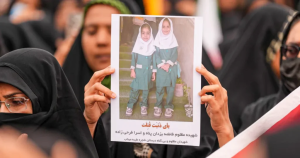
At a “No War” vigil on March 19, a woman originally from Iran came up to us and told us how happy she is that the U.S. is going to get rid of the regime in Iran, which has also killed so many people. She fully supports the U.S.-Israel war even though she has close family members living in harm’s way. We didn’t get a chance to point out the utter failure of similar goals in Afghanistan. Thousands of lives lost, millions of refugees, and billions of dollars that only increased terrorism there and beyond and brought the Taliban back to power.
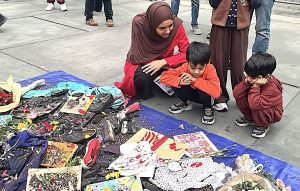
Video credit: Hideko Otake
Perhaps she would be touched by watching this video clip of a mother talking to her children about the Iranian schoolgirls killed by a U.S. missile. CodePink NYC called for an International Women’s Day rally in midtown Manhattan to remember the girls and cry out against war. Children’s shoes and rubble represented the destroyed elementary school where more than 170 died on the first day of the attack on Iran.
War tax resistance gets us talking about the money a lot, but, of course, at the heart of it is the human toll — the deaths, the injuries, the refugees, and the resources stolen from so many other needs.
A WTR counseling request came by email the other day with the subject, “I am agonizing over tax objection.” The 79-year-old woman, who had a long career working to prevent violence against women, has fragile finances and poor health now. She wrote of her distress about owing taxes and her “unwillingness to participate in the wanton violence happening in the world I expected to make better.”
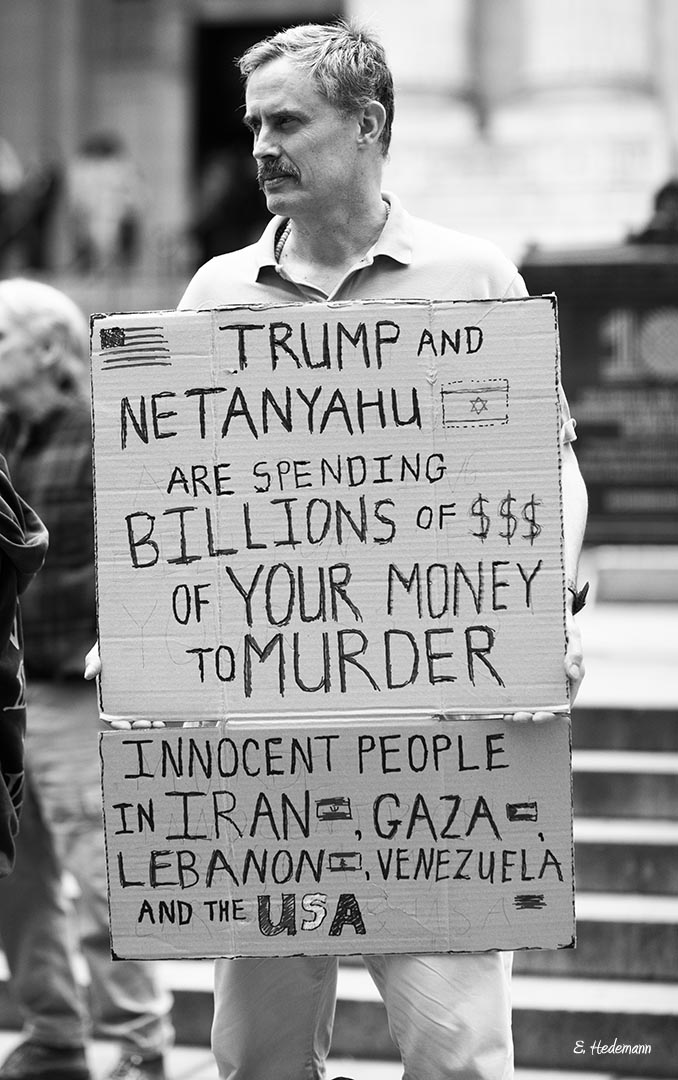
March 8, 2026. Photo by Ed Hedemann.
“The world I expected to make better.” That’s a phrase I’ve been wrestling with a lot lately. After decades of antiwar, peace and justice activism, not to mention millions in resisted war taxes and direct action arrests, how did we end up here?
While we wrestle with the answer to that question, the thousands of people who are “agonizing over tax objection” — or just doing it, damn the consequences — is absolutely heartening. The next generations of activists are out there picking up the mantle and bringing new energy and creativity to the struggle. Somehow we do have to continue to believe that the arc really does “bend toward justice,” not forgetting the other part of that MLK Jr. quote about the arc being long.
Still, we are allowed to be very, very angry that is it one helluva lot longer than we hoped.
Speaking of MLK, I’m reading Until the Last Gun Is Silent by Matthew F. Delmont. It’s about the intersection of the civil rights and Vietnam antiwar movements with a focus on racism in the military and for Black soldiers as they returned home. Delmont also writes about the anti-Vietnam War activism of Coretta Scott King and how her activism pushed Martin to speak out against the war. The backlash they both encountered is a reminder of what we are up against in this continuing struggle for a priority of people and planet over power and profiteering.
And, while it’s hard to keep the faces of so many children — the ones lost to war and the ones trying to understand it — in front of us, perhaps it does help give us the strength and determination to carry on with the struggle another day.
—Ruth Benn
P.S. As I was pondering a title to stick on this blog, an Iris Dement song popped into my head. She wrote Workin’ On A World at the time of the first Trump election.